

Searching for a record player with speakers can mean very different things depending on the product. The same phrase can describe a compact suitcase player, a turntable connected to powered speakers, or a furniture-grade console with the entire audio system built into one cabinet.
Those three categories make different tradeoffs in price, sound quality, space, and convenience. Choosing between them is less about finding one universally better option and more about deciding how much equipment, setup, and permanence makes sense for the room.
Portable All-In-One Record Players
Portable all-in-one players are the most common entry point into vinyl. They usually combine the turntable, amplifier, and small speakers into a single compact unit, often with Bluetooth or headphone connectivity added.
Their biggest advantage is simplicity. There are no separate speakers to place or components to connect, so someone can open the player, put on a record, and start listening almost immediately.
That convenience comes with limits. Small built-in speakers can only move so much air, while the compact enclosure leaves less room for the kind of acoustic design available in larger systems.
The turntable hardware also tends to be basic. Tonearm and cartridge adjustment may be limited or absent, and there is usually little room to upgrade individual parts later.
For someone who wants a low-cost way to start buying records, that may be perfectly acceptable. Listeners who become more interested in sound quality or equipment generally start looking for a system with more flexibility.
A Turntable With Powered Speakers
The next step up is a standalone turntable connected to a pair of powered speakers. Because the amplifier is built into the speakers, the setup can remain relatively simple without requiring a separate receiver.
Many modern turntables also include a built-in phono preamp. That keeps the number of components low while giving the turntable and speakers more room to do their respective jobs well.
Separating the speakers from the turntable also helps reduce vibration reaching the stylus. Speaker placement can be adjusted independently, which gives the listener more control over how the system sounds in the room.
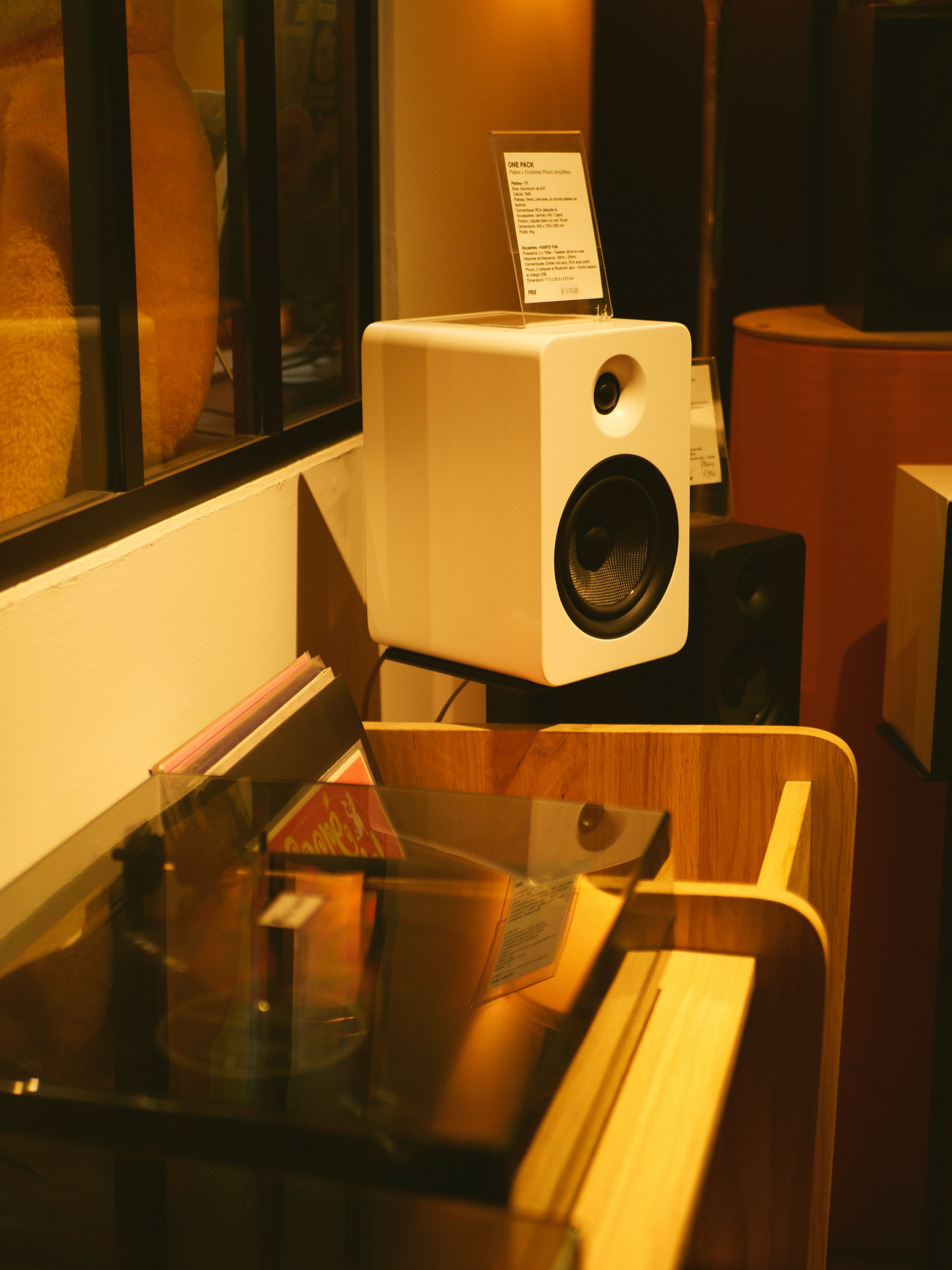
This category also offers a clear upgrade path. The speakers can be replaced without replacing the turntable, while the cartridge or phono stage can be upgraded later if the listener becomes more invested in the system.
The tradeoff is that the setup remains a group of components rather than one finished object. The turntable needs a stable surface, the speakers need appropriate placement, and records need somewhere to live.
For many people, that balance works well. The system can deliver strong sound without taking over the room, as long as the listener is comfortable managing the individual pieces.
The Integrated Record Console
The third category brings the turntable, amplification, speakers, and often record storage together in one piece of furniture.
This format has been around for decades. The vintage stereo cabinet became a familiar part of American living rooms in the middle of the twentieth century, when companies such as Magnavox and Zenith built audio systems into substantial wood cabinetry.
Those consoles solved an organizational problem that still exists today. Instead of spreading components across shelves and stands, the entire music system had one place in the room.
Age creates obvious limitations for original examples. Electronic components deteriorate, replacement parts can become difficult to source, and the turntables, amplifiers, and speakers were designed around technology available decades ago.
Modern consoles keep the basic format while updating the engineering.
Wrensilva approaches the category as a complete audio system built into furniture. Its consoles use a floating turntable design to isolate the stylus from speaker vibration, while the amplification and speakers are engineered around the cabinet rather than simply installed inside it.
Current Wrensilva systems also combine vinyl playback with modern sources such as Bluetooth and Sonos connectivity, depending on the model. That lets the console function as the room’s primary audio system without limiting it to records.
The result occupies a very different position from a portable all-in-one player. Both technically contain a record player with speakers, but one is designed primarily for convenience while the other is intended to remain a permanent part of the room.
That permanence is also the main tradeoff. A console costs more, takes up more space, and makes the audio system part of the furniture rather than something that can be easily moved or replaced.
Choosing The Right Format
Budget and listening habits usually narrow the decision quickly. A portable player makes sense for someone who wants an inexpensive and simple introduction to vinyl, while a turntable with powered speakers suits someone who wants better sound and the ability to upgrade over time.
Space matters just as much. Separate components need surfaces, speaker placement, and usually some kind of shelving or media console to keep everything organized.

An integrated console is better suited to someone who wants the audio system itself to contribute to the room. Instead of trying to hide equipment on a shelf, the cabinet becomes part of the design.
Upgradeability also differs between categories. Separate components provide the most flexibility, while all-in-one players and consoles are intended to function as complete systems from the start.
Three Different Answers To The Same Search
A record player with speakers can be a small portable unit, a turntable connected to powered speakers, or a full console designed as a piece of furniture. The phrase covers all three, even though the listening experience and level of commitment are completely different.
Knowing which category fits the room and the listener makes the search much easier. Once that decision is made, the number of realistic options gets much smaller.
Wrensilva
+18002926353
1995 Main St, San Diego, CA 92113
